Water Movement is a fantastic little bit of STEM science to do at home that shows the rather special water movement against gravity. It’s called Capillary Action.
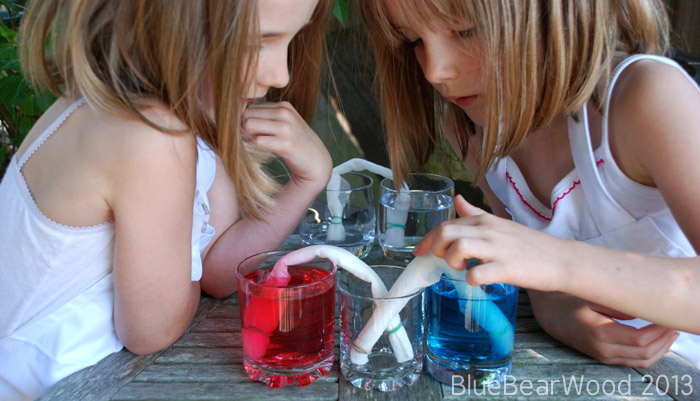
Capillary action is actually quite a hard concept to explain to younger children but don’t let that put you off talking about it or using the term. As I’ve said before, introducing children to big concepts and big words can only be a good thing. It doesn’t have to be ‘spot on’ correct and it can be a very high level explanation. The main thing is they get to see something fun and interesting that sparks their imagination.
Materials Needed To Show Capillary Action In Water Movement
- tap water,
- clear smallish glasses,
- kitchen roll
- small elastic bands.
- food colouring if you want to do some colour science as well
How To Set Up Your Capillary Action Experiment
Roll the kitchen roll up and secure each end with a small elastic band. You can make the rolled paper stronger by twisting them before you tie the ends with elastic bands.
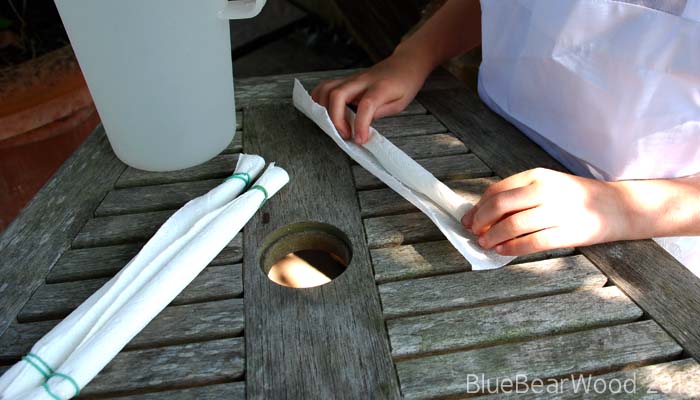
Fill one of the glasses almost to the top with water and put an empty glass next to it.

Bend the paper towel into an arch and place it into each glass and watch what happens.

The water will travel up the paper towel and into the empty glass until the level in each glass is the same.
Now it gets fun …
This time take three glasses and put them in a row. Pour water into the end glasses and leave the middle glass empty.

Add food colouring or paint to the water filled glasses and ask the children what they think will happen this time.
Place a piece of bent rolled kitchen roll from each glass of water into the empty glass and watch what happens.

The coloured water will move up the kitchen roll and into the empty glass until all the glasses are level but it will create a new colour. The colour of the middle glass will change depending on the two colours you had to start with.
Our glass made lavender coloured water.

To get a stronger colour add more pigment to start. If you watch the video at the bottom of this post you will see I had a much stronger purple colour.
Interestingly my girls thought it would take longer to fill the empty glass with two full glasses either side as there was more water to move.
The Science Explained
Water molecules like to stick to things including themselves (water is often referred to as being sticky). Sticking to things is called adhesion and sticking to itself is called cohesion (more big words). The cohesive nature of water is what gives it a strong surface tension.
Capillary action occurs in small spaces because of a combination of adhesion and cohesion.
Put your wrists together and cup your hands to make an open bowl shape. Imagine your fingers are the edges of the water sticking to the inside of a small tube. Push your fingers up straight keeping your wrists together. This is the adhesive nature of the water in a small space.
But water likes to stick to itself so will follow the water molecules sticking to the inside of the tube.
Bring your palms up to make the bowl shape again this acts like the cohesive nature of the water. This push pull type movement is (in a very broad way) how the water moves by capillary action.
Kitchen roll is a paper fabric made up of loosely woven paper fibres that creates lots of small holes. The water moves up the small holes using capillary action.
This is how the water in the glass it is able to move up the kitchen roll. Once it gets over the top of the curve gravity takes hold and helps pull the water down into the empty glass. Once the glasses have got the same level of water in them there will be a balance between the glasses. Both sides of the glass paper towel will reach saturation point and water movement will stop.
This was part of a regular Science hangout that I take part in. Have a look at the links below for some more great STEM Science At Home ideas on water.
BlueBearWood – Dissolving, Expanding and Bouncing Eggs
Life at the Zoo – Condensation Experiment
Science Sparks – Super Simple Surface Tension
I have to try this, looks really interesting!
The kids love it and you can tweak it to work in lots of different ways 🙂
we had tried this before but not successful. I will try again!
I’ve had a few people say they couldn’t get it to work. Don’t use tall glasses
My boys will love this, especially my nearly 5 year old. He’s fascinated by Science and loves to experiment and question 🙂